

Mastering the Basics: How to Cleanse Exfoliate Tone and Moisturize
Why the Cleanse Exfoliate Tone Moisturize Routine Is the Foundation of Healthy Skin
The cleanse exfoliate tone moisturize sequence is the most reliable four-step framework for building consistently healthier skin — and it works because each step prepares your skin for the next.
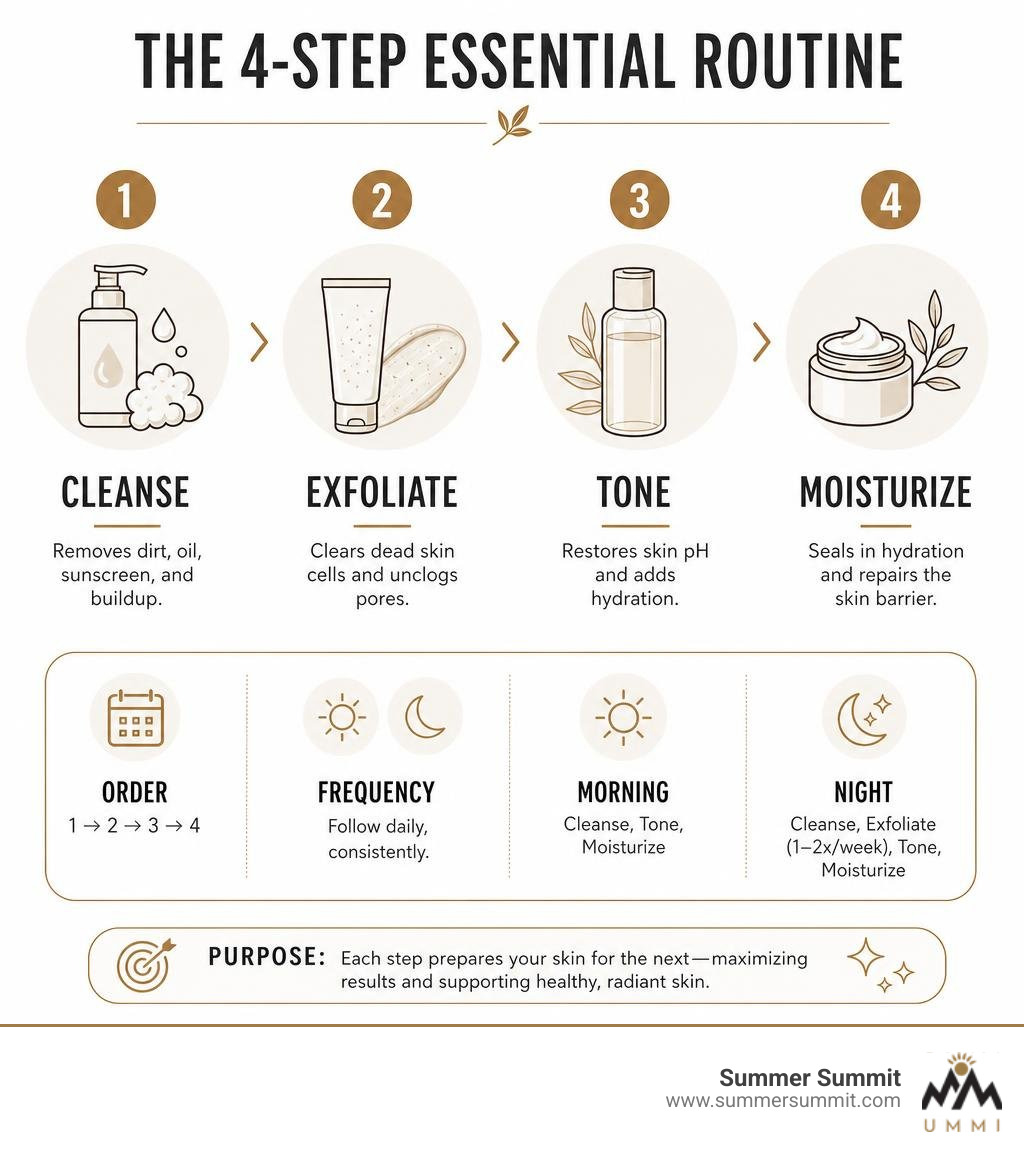
Here is the correct order and what each step does:
| Step | What It Does | How Often |
|---|---|---|
| 1. Cleanse | Removes dirt, oil, sunscreen, and buildup | Morning and night |
| 2. Exfoliate | Clears dead skin cells and unclogs pores | 1–2 times per week |
| 3. Tone | Restores skin pH and adds hydration | Morning and night |
| 4. Moisturize | Seals in hydration and repairs the skin barrier | Morning and night |
Most people spend money on expensive products but skip the basics — or do them out of order. The result? Products that sit on top of the skin instead of absorbing into it. Irritation. Half-empty bottles. Frustration.
The good news: you don't need a 10-step routine. Research consistently shows that a simple four-step routine done daily outperforms a complex one done occasionally. Most people start seeing real changes in skin texture and tone after 4–6 weeks of consistency — which lines up with the skin's natural renewal cycle.
I'm Robert McCann, founder of Summer Summit Skincare, and I've spent years working directly with labs and formulation experts to understand how ingredients interact across every step of the cleanse exfoliate tone moisturize routine. That hands-on experience shapes everything in this guide. Let's walk through each step so you can build a routine that actually sticks.
The Science Behind the Cleanse Exfoliate Tone Moisturize Routine
To get the most out of your skincare investments, understanding the biological "why" behind product sequencing is key. Applying products randomly is like trying to paint a wall before scraping off the peeling old paint—it simply won't stick, and the results will be messy.
The golden rule of skincare application is to layer products from thinnest to thickest consistency. Water-based formulas with small molecular structures go first so they can sink directly into the skin. Thicker, oil-based products go last to seal everything in. If you apply a heavy moisturizer first, it forms an occlusive barrier that prevents lightweight toners, serums, or exfoliating acids from ever reaching your skin cells.
According to clinical dermatology guidelines on The Correct Order for Skin Care Products , a structured sequence ensures optimal absorption and minimizes the risk of irritation. When we practice proper layering skincare, we work in harmony with the skin barrier—the stratum corneum—and protect the delicate acid mantle.
Morning routines should focus on defense and protection, while nighttime routines are dedicated to repair and cellular renewal.
Step 1: Cleanse to Prepare Your Canvas
The foundation of any routine is a clean surface. Throughout the day, your face accumulates sebum, environmental pollutants, dead skin cells, and sunscreen. If you don't wash these away, you are essentially sealing dirt into your pores when you apply subsequent steps.
For many, double cleansing in the evening is a game-changer. This involves using an oil-based cleanser first to break down makeup and SPF, followed by a gentle water-based cleanser to wash away remaining impurities.
However, the key to skin care cleansing without drying skin is avoiding hot water and harsh surfactants. Hot water strips natural lipids, leaving your skin vulnerable and tight. Instead, use lukewarm water and follow the 60-second rule: massage your cleanser gently for a full minute to allow the active cleansing agents to bind to oil and debris before rinsing.
Step 2: Exfoliate to Renew and Resurface
If cleansing prepares the canvas, exfoliation is what refines it. Your skin naturally sheds dead cells, but this process slows down as we age, leading to a dull, rough complexion and clogged pores.
When you clean and exfoliate regularly, you remove this buildup of dead tissue. This instantly brightens your skin and ensures that your toner and moisturizer can actually penetrate the skin barrier instead of sitting on a layer of dead cells.
Step 3: Tone to Balance and Hydrate
Historically, toners were astringent, alcohol-laden liquids designed to strip away excess oil (often leaving skin burning and red). Thankfully, modern skincare has evolved. Today, toners are hydrating, soothing formulations designed to restore your skin's optimal pH level (which is slightly acidic, around 4.5 to 5.5) after cleansing and exfoliating.
Applying toner to damp skin acts like a sponge. A dry sponge struggles to absorb liquid, but a damp sponge drinks it up instantly. By flooding your skin with hydration immediately after cleansing, you maximize the absorption of your moisturizer. If you are still on the fence about this step, ask yourself: should i add toner to my skincare routine? The answer is almost always yes if you struggle with dehydration or uneven texture.
Step 4: Moisturize to Lock in Hydration
Moisturizing is the non-negotiable grand finale. Regardless of your skin type, your skin experiences transepidermal water loss (TEWL) overnight and throughout the day, where moisture evaporates into the air.
A well-formulated moisturizer acts as a protective shield, sealing in the hydration from your toner and reinforcing your skin barrier with lipids, ceramides, and fatty acids. your skin type matters with moisturizers—oily skin needs lightweight, water-based gels, while dry skin thrives on richer, emollient creams.
Integrating Exfoliation into Your Daily CTM Routine
Exfoliation is the most powerful "active" step in the cleanse exfoliate tone moisturize routine, but it is also the easiest to overdo. To keep your skin barrier happy, exfoliation should be treated as a targeted treatment performed 1 to 2 times per week, rather than a daily chore.

Choosing the right method is crucial for beginner safety. Let's look at how physical and chemical exfoliants compare:
| Feature | Physical Exfoliation | Chemical Exfoliation |
|---|---|---|
| Mechanism | Manual friction (scrubs, brushes, grains) | Dissolving cellular bonds (AHAs, BHAs, enzymes) |
| Precision | Uneven; depends on hand pressure | Highly uniform and controlled |
| Barrier Risk | High (can cause micro-tears) | Low (when used correctly) |
| Best For | Normal, resilient skin types | All skin types, especially acne-prone or sensitive |
Why Chemical Exfoliation is Safer for Beginners
It sounds counterintuitive—applying "acids" to your face sounds intimidating, while a gentle-sounding "apricot scrub" feels safe. In reality, the opposite is true. Physical scrubs with jagged particles (like crushed shells or pits) can create microscopic tears in the skin barrier, leading to moisture loss, redness, and bacterial acne spread.
Chemical exfoliants, on the other hand, use mild acids or natural enzymes to gently loosen the "glue" holding dead skin cells together.
- Alpha Hydroxy Acids (AHAs), like glycolic or lactic acid, are water-soluble and work on the skin's surface, making them excellent for dry skin and hyperpigmentation.
- Beta Hydroxy Acids (BHAs), primarily salicylic acid, are oil-soluble. They penetrate deep inside pores to dissolve sebum, making them the ultimate choice for oily and acne-prone skin.
- Enzymatic Exfoliants (derived from papaya, pineapple, or pumpkin) are the gentlest of all, making them perfect for highly sensitive skin.
How to Safely Cleanse Exfoliate Tone Moisturize Without Irritation
To introduce exfoliation safely, always patch-test a new product on your inner arm or jawline for 24 to 48 hours.
Because exfoliating makes your skin more sensitive to environmental stressors, it is highly recommended to perform this step during a simple nighttime skincare routine.
Start by cleansing your face thoroughly and patting it completely dry (applying acids to wet skin can increase penetration and cause irritation). Apply your exfoliant, let it work its magic for the recommended time, and then follow up with a soothing toner and a rich, barrier-repairing moisturizer to calm the skin.
Tailoring the 4-Step Routine to Your Specific Skin Type
There is no "one-size-fits-all" in skincare. Your skin is a living, dynamic organ that responds to its environment, hormones, and genetics. To get the best results, you must adapt your cleanse exfoliate tone moisturize routine to your skin's unique personality.

Customizing for Combination and Sensitive Skin
If you have combination skin, you are dealing with two different climates on one face: an oily T-zone (forehead, nose, and chin) and dry cheeks. When learning tips to take care of combination skin, zoning is your best friend. Apply a clay mask or a BHA exfoliant strictly to your oily T-zone, and use a richer, hydrating moisturizer on your cheeks.
For sensitive skin, the goal is simple: avoid irritation. Look for fragrance-free, hypoallergenic formulas. Skip physical scrubs entirely and opt for ultra-gentle PHA (polyhydroxy acid) chemical exfoliants, which have larger molecules that do not penetrate as deeply, ensuring a surface-level polish without the sting.
Managing Dry and Oily Skin Types
If your skin feels tight, flaky, or dull, you are likely dealing with dry skin. When executing tips to take care of dry skin daily, skip the morning cleanser and simply rinse with lukewarm water. Use a hydrating, creamy cleanser at night, a lactic acid exfoliant once a week, and a rich moisturizer packed with ceramides to rebuild your lipid barrier.
Conversely, if your face develops a shiny layer by midday, you have oily skin. The biggest mistake here is trying to strip the oil away with harsh, drying products. This actually triggers a panic response, causing your skin to produce more oil to compensate.
Instead, follow targeted tips to take care of oily skin daily: use a gentle foaming gel cleanser, a salicylic acid (BHA) exfoliant to keep pores clear, and a lightweight, oil-free gel moisturizer that hydrates without clogging.
Managing Acne-Prone Skin with the Cleanse Exfoliate Tone Moisturize Method
For acne-prone skin, consistency and non-comedogenic (non-pore-clogging) ingredients are vital. Cleanse twice daily to keep bacteria at bay, and use a BHA exfoliant 1 to 2 times a week to clear out deep-seated clogs. Follow with a soothing, alcohol-free toner containing niacinamide or centella asiatica to reduce redness, and seal it with a lightweight moisturizer. Keeping your skin hydrated actually signals your sebaceous glands to slow down sebum production, leading to fewer breakouts over time.
Common Mistakes and Ingredient Conflicts to Avoid
When it comes to active skincare, more is not always better. One of the most common mistakes we see in 2026 is "stacking actives"—using multiple powerful ingredients like retinol, vitamin C, benzoyl peroxide, and exfoliating acids all in the same session. This overload damages the skin barrier, leading to redness, flaking, and a painful stinging sensation when applying even the gentlest moisturizers.
If your skin stings when you apply a basic moisturizer, your skin barrier is compromised. You need to hit the pause button on all actives and strip your routine back to the absolute basics: a gentle cleanser, a soothing toner, and a barrier-repairing cream until your skin recovers.
How to Space Out Retinol, Vitamin C, and Exfoliating Acids
To get the benefits of these powerhouse ingredients without the irritation, you must learn to space them out. A great strategy is separating them by time of day or utilizing a "skin cycling" schedule.
- Morning Routine: Keep this focused on protection. Use your Vitamin C serum in the morning—it is a fantastic antioxidant that pairs beautifully with sunscreen to neutralize free radicals. Check out our guide on a simple daytime skincare routine for a seamless AM flow.
- Night Routine: This is for treatment and repair. If you use retinol, do not use your exfoliating acids on the same night. Instead, alternate them.
-
The Skin Cycling Method:
- Night 1: Exfoliate (Cleanse, Exfoliate, Tone, Moisturize)
- Night 2: Retinol (Cleanse, Tone, Retinol, Moisturize)
- Nights 3 & 4: Recovery (Cleanse, Tone, Hydrating Serum, Moisturize)
- Repeat
For a deeper dive into structuring your PM schedule, read through our tips for a simple nighttime skincare routine.
Frequently Asked Questions About the 4-Step Routine
How long does it take to see results from a consistent cleanse-exfoliate-tone-moisturize routine?
While some benefits like surface hydration and instant brightness from exfoliation can be seen immediately, true structural changes take time. Because your skin cells take about 28 to 45 days to fully renew, you should expect to see visible improvements in dark spots, fine lines, and overall acne reduction after 4 to 6 weeks of daily, consistent practice.
Should I exfoliate in the morning or at night?
It is highly recommended to exfoliate at night. Chemical exfoliants (especially AHAs like glycolic acid) remove the top layer of dead skin cells, making your fresh, new skin highly sensitive to UV damage. Exfoliating in the evening allows your skin to recover overnight in a controlled, sun-free environment while you sleep.
Is sunscreen necessary if I only exfoliate once a week?
Yes, daily sunscreen is absolutely non-negotiable. Exfoliating even once a week increases your skin's sun sensitivity for up to seven days after application. Skipping sunscreen not only invites painful sunburns, but it also accelerates premature aging, hyperpigmentation, and collagen breakdown—rendering the rest of your skincare routine useless. Always finish your morning routine with a broad-spectrum SPF 30 or higher.
Conclusion
Mastering your skincare doesn’t require a complex, overwhelming vanity drawer. By focusing on the core cleanse exfoliate tone moisturize framework, you give your skin exactly what it needs to thrive: a clean canvas, regular renewal, balanced pH, and deep hydration.
At Summer Summit, we believe in the power of simplicity. Our dermatologist-formulated, premium skincare products are clinically proven, cruelty-free, and entirely free of sulfates, parabens, and harmful irritants. We are so confident in our formulas that we back every single purchase with a 100% satisfaction guarantee, plus free shipping to your door.
Ready to take your skin health to the next level? Explore more expert skincare guides on the Summer Summit Blog and build a routine that brings out your natural, healthy glow.
Leave a comment