

How to Use Kojic Acid Cream Like a Pro
Why Getting Kojic Acid Cream Right Makes All the Difference
Knowing kojic acid cream how to use it correctly is the difference between real results and a half-empty bottle that didn't do much. If you want the short version, here it is:
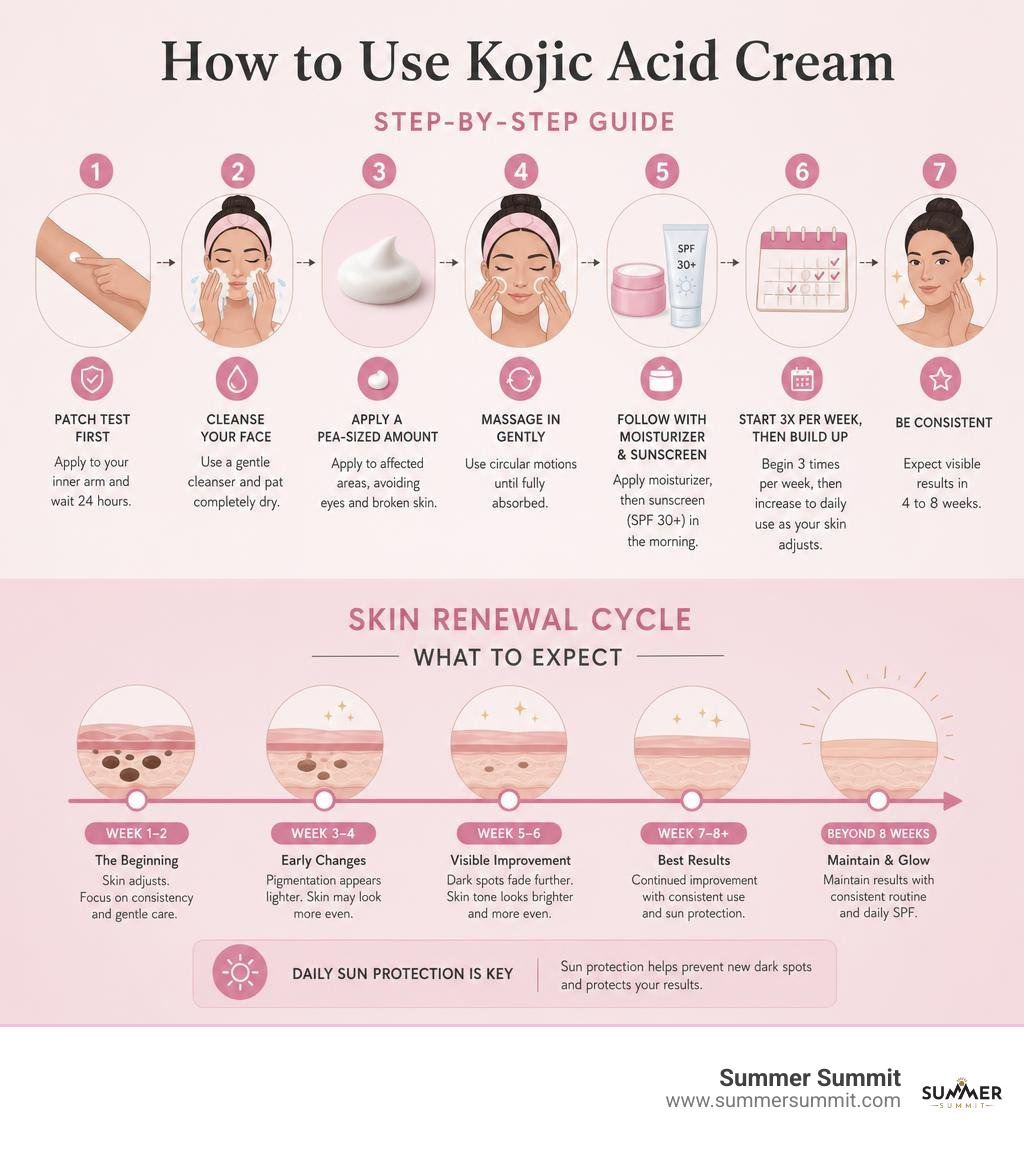
How to use kojic acid cream (quick guide):
- Patch test first — apply to your inner arm and wait 24 hours
- Cleanse your face with a gentle cleanser and pat completely dry
- Apply a pea-sized amount to affected areas, avoiding eyes and broken skin
- Massage in gently using circular motions until fully absorbed
- Follow with moisturizer, then sunscreen (SPF 30+) in the morning
- Start 3x per week, then build up to daily use as your skin adjusts
- Be consistent — expect visible results in 4 to 8 weeks
Dark spots, uneven skin tone, and stubborn melasma are frustrating — especially when you've already tried products that promised results and delivered nothing. Kojic acid is one of the most well-researched brightening ingredients available without a prescription. It works by blocking the enzyme that triggers melanin production, targeting pigmentation at the source rather than just masking it.
But the ingredient only works when it's used correctly. Too much, too fast, on skin that isn't prepped? You'll get irritation before you get results.
I'm Robert McCann, founder of Summer Summit Skincare, and my work developing evidence-based formulations has given me hands-on experience evaluating how actives like kojic acid perform across different skin types and routines — exactly the kind of practical knowledge that shapes kojic acid cream how to use guidance you can actually trust. In the sections below, I'll walk you through everything you need to use it safely and effectively.
What is Kojic Acid and Its Key Benefits?
Before we dive into the exact steps of application, it is helpful to understand what this ingredient actually is. Kojic acid is a naturally occurring compound discovered in Japan. Interestingly, it shares its scientific origins with the traditional fermentation processes used to make Japanese sake, soy sauce, and rice wine. It is a natural byproduct of fermenting certain types of fungi, specifically Aspergillus oryzae (often called "koji" in Japanese culinary traditions).
In modern skincare, we value it because it is an incredibly effective, non-prescription tyrosinase inhibitor. Instead of aggressively bleaching your skin surface like harsh chemical agents, it works biologically in the upper layers of the skin to limit the pathways that lead to excess pigmentation.

How Kojic Acid Works to Lighten Skin
To understand how kojic acid works, we have to look at how our skin creates pigment. Melanin is the pigment that gives our skin, hair, and eyes their color. It is produced by specialized cells called melanocytes. The rate-limiting, essential enzyme in this entire biological process is called tyrosinase.
When your skin is exposed to UV light, hormonal shifts, or physical trauma (like an acne breakout), tyrosinase is activated to convert the amino acid tyrosine into melanin. Kojic acid works by directly binding to and blocking tyrosinase. By preventing this enzyme from doing its job, it stops excess pigment production at the source.
If you are wondering whether your dark marks fall into this category, you can learn more about identifying your specific skin concerns in our article do i have hyperpigmentation. For a deeper dive into the science of melanin inhibition, you can also check out this helpful KOJIC ACID: EVERYTHING YOU NEED TO KNOW Q&A video.
Key Benefits for Hyperpigmentation and Dark Spots
Topical application of kojic acid cream offers a wide range of cosmetic and therapeutic benefits:
- Fades Sunspots and Age Spots: It targets the accumulated melanin deposits caused by years of ultraviolet exposure, helping them blend back into your natural skin tone.
- Reduces Post-Inflammatory Hyperpigmentation (PIH): It is excellent for fading those stubborn dark marks left behind after acne blemishes or minor skin injuries heal.
- Improves Melasma: When used consistently over several months, it helps fade the symmetrical, hormonally triggered patches of melasma. If you are unsure which one you have, read our breakdown of melasma vs hyperpigmentation to understand the differences.
- Brightens Dull Complexions: It promotes a more uniform, radiant overall skin tone. You can find more tips on achieving this in our guide on getting rid of unwanted dark spots.
- Antimicrobial and Antifungal Properties: Beyond its cosmetic brightening abilities, kojic acid has mild antimicrobial and antifungal properties. This makes it highly beneficial for those prone to mild acne or fungal skin conditions like ringworm, candidiasis, and athlete's foot.
Kojic Acid Cream How to Use: A Step-by-Step Guide
How you apply your cream determines both its safety and its efficacy. Applying active ingredients incorrectly is the number one reason people experience redness, peeling, or a compromised skin barrier.

Step-by-Step Application Routine for Beginners
To get the most out of your cream while keeping your skin happy, we recommend following this structured, dermatologist-approved nighttime routine:
- Wash Your Hands: Always start by washing your hands thoroughly with soap and water to avoid transferring bacteria to your face.
- Cleanse Your Skin: Wash your face with a mild, sulfate-free cleanser and lukewarm water. Massage the cleanser gently over your skin for about 60 seconds, then rinse thoroughly.
- Dry Your Skin Completely: Pat your face dry with a clean, soft towel. Now, wait 5 to 10 minutes. Applying active ingredients to completely dry skin significantly reduces the risk of irritation, as damp skin absorbs products much faster and deeper.
- Dispense a Pea-Sized Amount: You do not need a lot of product. Take a small, pea-sized amount of your face cream with kojic acid on your fingertips.
- Apply to Target Areas: Apply the cream in small dots directly onto the affected areas of hyperpigmentation, or spread it in a very thin, even layer across your entire face, depending on your product's instructions. Strictly avoid the delicate eye area, the corners of your mouth, and any broken or irritated skin.
- Massage It In: Gently massage the cream into your skin using upward, circular motions until it is fully absorbed.
- Allow Time for Absorption: Wait 10 to 15 minutes to let the cream fully penetrate the upper layers of your skin before applying anything else.
- Follow with Moisturizer: Apply a hydrating moisturizer to lock in moisture and support your skin barrier. Look for moisturizers containing nourishing ingredients like hyaluronic acid, ceramides, or aloe vera.
- Protect with Sunscreen (Morning Routine): If you are applying your cream in the morning, you must follow up with a broad-spectrum sunscreen of SPF 30 or higher as your final step.
For more helpful application tips, you can read the guide on How to Use Kojic Cream for Flawless, Radiant Skin.
How to Safely Introduce Kojic Acid Cream into Your Routine
When introducing any high-performance active to your skin, a slow-exposure schedule is always best.
Before applying it to your face for the first time, you should perform a patch test. Apply a tiny amount of the kojic acid face cream to a discreet area, such as your inner forearm, behind your ear, or the side of your neck. Wait 24 hours to observe your skin. If you do not experience any redness, itching, burning, or swelling, it is safe to proceed.
To build up your skin's tolerance, start by applying the cream just three nights a week (or once every two days). If your skin feels comfortable and shows no signs of irritation after two weeks, you can gradually increase the frequency to once daily, preferably in the evening. Only move to twice-daily application (morning and night) if your skin tolerates it perfectly and your product formulation is designed for twice-daily use.
How to Choose, Layer, and Compare Kojic Acid Cream
Not all skincare products are created equal. To get the best results, you need to understand how to select the right formulation and how to layer it safely with other products in your cabinet.
Choosing the Right Concentration and Formulation
When shopping for a kojic acid product, pay close attention to the ingredient concentration and the overall formulation:
- Concentration Levels: The Cosmetic Ingredient Review Expert Panel has officially deemed kojic acid safe for use in cosmetics at concentrations of 1% or less. A 1% concentration is a gentle, highly effective entry point for beginners. Stronger, highly targeted corrective formulas may use up to 2% or 3% concentrations, but these carry a higher risk of irritation and should be introduced with extra care. You can find official clinical guidelines on standard concentrations in the Label: KOJIC ACID CREAM cream database entry.
- Formulation pH: Kojic acid is highly sensitive to light and air, meaning it can oxidize (turn brown and lose its potency) if not formulated correctly. Look for creams with a stable, slightly acidic pH level (around 3.5 to 4.0) to ensure optimal penetration and stability.
- Synergistic Ingredients: Kojic acid works best when it is paired with other brightening actives that target different pathways of melanin production. Look for creams that combine it with ingredients like Alpha Arbutin, Niacinamide, or Tyrostat™ 09 (a natural botanical extract from the Northern Canadian prairies that has been shown to decrease melanin density by 7.3% in just 3 weeks).
What Ingredients to Pair and Avoid Mixing
Layering the right ingredients can amplify your brightening results, while mixing the wrong ones can lead to a compromised skin barrier and severe irritation.
- What to Pair With: Kojic acid pairs beautifully with hydrating and soothing ingredients like Hyaluronic Acid, Glycerin, and Ceramides. It also works in perfect synergy with Niacinamide (which improves skin brightness by 68% after 4 weeks) and Vitamin C. Combining these ingredients provides a multi-targeted approach to fading dark spots. If you want to explore this powerful combination, read our guide on kojic acid and vitamin c cream.
- What to Avoid Mixing: When you first start using a kojic acid cream, avoid applying it in the same routine step as other strong actives. Do not mix it directly with retinoids (like retinol or tretinoin), strong chemical exfoliants (AHAs like glycolic acid or BHAs like salicylic acid), or benzoyl peroxide. If you want to use these ingredients, use them at different times of the day (e.g., Vitamin C and Kojic Acid in the morning, Retinol at night) or alternate nights to keep your skin barrier safe.
Kojic Acid vs. Vitamin C, Alpha Arbutin, and Hydroquinone
How does kojic acid stack up against other popular skin-brightening ingredients? Let's compare them:
| Ingredient | Primary Mechanism of Action | Best Used For | Irritation Risk | Timeline for Results |
|---|---|---|---|---|
| Kojic Acid | Inhibits tyrosinase enzyme activity | Sunspots, melasma, post-acne marks, and mild fungal issues | Moderate (can cause contact dermatitis if overused) | 4 to 8 weeks |
| Vitamin C | Antioxidant; neutralizes free radicals and inhibits melanin | Overall brightness, environmental protection, and light fading | Low to Moderate (depending on pH and concentration) | 4 to 8 weeks |
| Alpha Arbutin | Biosynthetic tyrosinase inhibitor | Dark spots, evening skin tone, and localized hyperpigmentation | Very Low (exceptionally gentle) | 8 to 12 weeks |
| Hydroquinone | Destroys melanocytes and inhibits melanin synthesis | Severe, stubborn melasma and deep hyperpigmentation | High (requires medical supervision; banned in some regions) | 4 to 12 weeks |
To learn more about these individual ingredients, read our articles on vitamin c the powerful skin brightening agent and our kojic acid vitamin c cream complete guide.
Managing Side Effects and Body Application
The most common side effect associated with kojic acid is contact dermatitis. This can present as redness, itching, dryness, flakiness, or mild swelling. If you experience these symptoms, immediately discontinue use. You can apply an over-the-counter hydrocortisone cream to soothe the immediate irritation and focus on hydrating, barrier-repairing moisturizers. Once your skin has completely healed, you can try reintroducing the cream at a lower frequency or concentration, or consult a dermatologist.
While many people use kojic acid on their face, it is also highly effective for treating hyperpigmentation on the body. It is commonly used to brighten dark areas prone to friction and shaving irritation, such as:
- The underarms
- Elbows and knees
- The back of the hands (to fade age spots)
- The inner thighs
For official ingredient ratios and clinical safety warnings on multi-active brightening creams, you can refer to the Label: KOJIC ACID GLUTATHIONE CREAM lotion/shampoo database entry. For more advice on managing skin sensitivity, check out How to use Kojic Acid Cream - Dr. Sakhiya's.
Frequently Asked Questions About Kojic Acid Cream
Timeline for Results: Kojic Acid Cream How to Use
A common question we receive is: How long does it take to see results?
Topical skin brightening is a journey, not a sprint. Your skin operates on a natural renewal cycle that takes about 21 to 28 days to push new, healthy skin cells to the surface. Because of this, you may begin to notice subtle improvements in skin texture and overall brightness within the first 3 to 4 weeks of consistent use.
Significant fading of dark spots, sun damage, and uneven skin tone typically takes between 4 to 8 weeks. For deeper, more stubborn pigmentation like melasma, it can take up to 3 months of consistent, daily use to see optimal results. We highly recommend taking a photo of your skin on Day 1 in consistent lighting, and comparing it to a photo on Day 30 — mirror checks can make it easy to miss the gradual, daily progress your skin is making!
Pregnancy and Breastfeeding Safety: Kojic Acid Cream How to Use
If you are currently pregnant or breastfeeding, safety is your top priority. While kojic acid is a naturally derived ingredient with relatively poor systemic absorption below the surface of the skin, clinical data regarding its safety during pregnancy and lactation is limited.
For this reason, we highly recommend pausing the use of active brightening creams like kojic acid during pregnancy and breastfeeding, or consulting directly with your OB-GYN or dermatologist before using them. Focus instead on gentle, hydrating ingredients like hyaluronic acid and physical sunscreens until you get the green light from your healthcare provider.
Do I Need to Use Sunscreen with Kojic Acid Cream?
Yes, absolutely, without exception! This is the most crucial step of the entire routine.
Kojic acid actively reduces the production of melanin in your skin. Melanin is your body's natural defense mechanism against ultraviolet (UV) radiation. By lowering your skin's melanin levels, kojic acid makes your skin significantly more photosensitive and susceptible to sunburn.
If you skip sunscreen while using a brightening cream, the UV exposure will immediately trigger your melanocytes to produce more pigment, reversing all of your progress and making your dark spots even darker. Always apply a broad-spectrum sunscreen of SPF 30 or higher every single morning, and reapply it every two hours if you are spending time outdoors.
To find the best protective formulas for your routine, read our guides on the best face cream to reverse sun damage and the best moisturizer for sun damage.
Conclusion
Using kojic acid cream is an incredibly effective, scientifically backed way to fade dark spots, even out your skin tone, and reclaim a radiant complexion. By performing a patch test, introducing the product slowly, keeping your skin hydrated, and committing to daily sun protection, you can achieve beautiful, visible results safely.
At Summer Summit, we believe in creating premium, evidence-based skincare solutions that deliver real results without compromising your skin health. Our dermatologist-formulated products are proudly 100% cruelty-free and entirely free of sulfates, parabens, and harmful chemical irritants. We stand behind our formulations with a 100% satisfaction guarantee and offer free shipping on all orders to help you start your journey to glowing skin with complete peace of mind.
If you have any questions about how to build your perfect brightening routine, explore our clinical guides on the Summer Summit Blog. We are always here to help you glow with confidence!
Dejar un comentario