

A–Z Guide to Hyaluronic Acid Serum
What Is Hyaluronic Acid and How Does It Benefit Your Skin?
Hyaluronic acid serum is a water-based skincare product that draws moisture into the skin, helping it look plumper, smoother, and more hydrated. Here's a quick summary of what it does and why it works:
- What it is: A lightweight serum containing hyaluronic acid, a molecule your body produces naturally
- How it works: Acts as a humectant - it pulls water from the air and deeper skin layers to hydrate the surface
- Key benefits: Reduces the appearance of fine lines, improves elasticity, and plumps dehydrated skin
- Who it's for: All skin types, including sensitive and acne-prone skin
- When to apply: After cleansing, on damp skin, before your moisturizer
- How fast it works: Many people notice softer skin within a week; fine line improvement typically takes 4-6 weeks
Here's something worth knowing if you're skeptical of skincare claims: hyaluronic acid is one of the most well-studied hydrating ingredients in dermatology. A published clinical study found that topical hyaluronic acid serum increased skin hydration by 55% after six weeks of consistent use - and by 134% immediately after a single application. That's not marketing language. That's corneometry data.
If you've spent money on products that promised glowing skin and delivered nothing, you're not alone. The skincare aisle is full of hype. But hyaluronic acid is different - it has the science behind it.
I'm Robert McCann, founder of Summer Summit Skincare, and I've spent years working directly with labs and ingredient suppliers to understand exactly how actives like hyaluronic acid serum perform at a formulation level. In this guide, I'll break down everything - from molecular weights to layering techniques - so you can cut through the noise and actually get results.
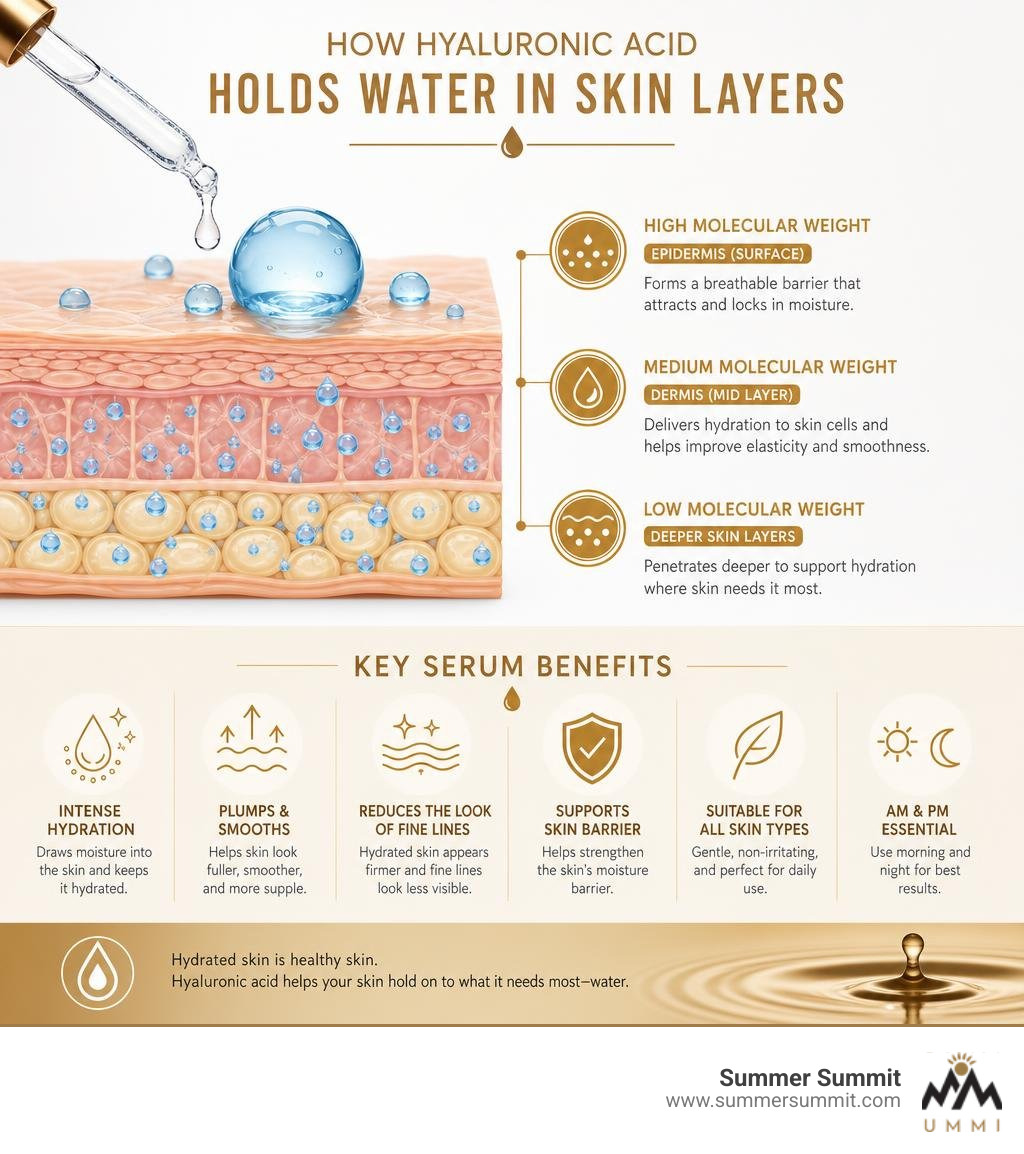
To understand why a hyaluronic acid serum is so celebrated in the beauty community, we first have to look at our own biology. Hyaluronic acid (HA) is a naturally occurring, slippery polysaccharide found throughout the human body. In fact, the average adult body contains about 15 grams of HA, with roughly one-third of that supply being degraded and synthesized anew every single day. Nearly half of your body's total hyaluronic acid resides right in your skin, where it acts as a primary component of the extracellular matrix. For additional scientific background, this peer-reviewed overview on hyaluronan in skin explains its role in skin moisture, structure, and aging.
Its superpower? Water retention. A single gram of hyaluronic acid can hold up to six liters of water. In terms of topical skincare, this means HA behaves like a molecular sponge, binding moisture to the skin surface to prevent dehydration.
When we apply a high-quality hydrating serum, we unlock several key benefits:
- Intense Surface Hydration: By acting as a biological humectant, it rapidly increases the water content of the epidermis.
- A Visible Plumping Effect: Flooding the skin cells with moisture temporarily swells the intracellular spaces, resulting in firmer, bouncier skin.
- Smoothing of Fine Lines: Dehydrated skin highlights creases and texture. HA fills in these dry gaps, visibly softening fine lines and minor wrinkles.
- Enhanced Skin Elasticity: Well-hydrated skin is more flexible, resilient, and better able to snap back into place.
To learn more about how this molecule transforms dull complexions, read our comprehensive guide on the Surprising Benefits Of Hyaluronic Acid Serum For Your Skin (also available in Spanish as Surprising Benefits Of Hyaluronic Acid Serum For Your Skin).
The clinical data backing these benefits is incredibly robust. In a rigorous 6-week clinical study evaluating topical hyaluronic acid serum on facial photoaging, researchers measured a 55% sustained increase in skin hydration by week six. Furthermore, participants experienced a 64% improvement in skin smoothness, a 60% improvement in plumping, and a 43% improvement in overall global skin appearance. These numbers prove that consistent topical application physically alters the skin's moisture profile and texture over time.
At Summer Summit, we formulated our own hydrating solutions to harness these exact scientific benchmarks. We believe that clinical-grade hydration should be clean, cruelty-free, and accessible to everyone looking to restore their natural glow.
Understanding Molecular Weights in a Hyaluronic Acid Serum
If you have ever looked at the back of a skincare bottle, you might have noticed ingredients like Sodium Hyaluronate, Sodium Hyaluronate Crosspolymer, or Hydrolyzed Hyaluronic Acid. These are different forms and molecular weights of the same basic compound, and they behave very differently on your skin.
To get the most out of your hydration routine, a serum must utilize a spectrum of molecular weights:
- High Molecular Weight HA (1,000 to 1,400 kDa): These large molecules cannot penetrate the stratum corneum (the outermost skin barrier). Instead, they sit comfortably on the surface of your skin, forming a breathable, protective film that prevents transepidermal water loss (TEWL). This delivers that instant, silky-smooth feeling and immediate surface plumping.
- Medium Molecular Weight HA: These mid-sized molecules work just below the immediate surface, helping to support the skin's barrier function and maintain middle-layer moisture.
- Low and Ultra-Low Molecular Weight HA (20 to 300 kDa): These tiny molecules are small enough to pass through the stratum corneum. They sink deep into the epidermis to provide sustained, long-term hydration. Crucially, research shows that low-molecular-weight HA can actually signal your skin to boost its own endogenous dermal hyaluronan production.
Using a single-weight serum is like trying to paint a house with only one size of brush - you miss the fine details and the broad strokes. For a deeper look into the chemistry of these molecular sizes, check out our breakdown on Whats With The Hype About Hyaluronic Acid Ha or read the Canadian edition Whats With The Hype About Hyaluronic Acid Ha.
Key Ingredients to Pair with Your Hyaluronic Acid Serum
While hyaluronic acid is a magnificent solo performer, it becomes an absolute powerhouse when paired with the right supporting cast. Combining HA with ingredients that repair the skin barrier or stimulate collagen production creates a synergistic effect that yields far better results than HA alone.
Here are the top ingredients you should look for alongside hyaluronic acid:
1. Ceramides
If hyaluronic acid is the water filling your skin's biological pool, ceramides are the concrete walls keeping the water from leaking out. Ceramides are natural lipids that make up over 50% of your skin barrier. When paired with HA, they lock in the moisture that the humectant attracts, ensuring your skin stays plump and hydrated for hours. This combination is highly recommended for restoring a compromised skin barrier.
2. Vitamin B5 (Panthenol)
Pro-vitamin B5 is a natural skin healer and humectant. It works in tandem with HA to soothe irritated skin and accelerate tissue repair. More importantly, panthenol actively supports the biological production of your skin's own barrier lipids, such as ceramides and fatty acids. This dual-action approach results in a stronger, healthier skin barrier.
3. Peptides (such as Matrixyl 3000)
Peptides are short chains of amino acids that act as cellular messengers. When combined with a hyaluronic acid serum, peptides like Matrixyl 3000 send signals to your skin cells to produce more collagen and elastin. This helps to firm, lift, and smooth out deeper wrinkles while the HA keeps the surface bouncy and fresh.
At Summer Summit, we make it a point to design our formulas around these synergistic relationships. We focus on clean, dermatologist-formulated pairings that avoid sulfates, parabens, synthetic fillers, and other harmful irritants. By choosing clean chemistry, you avoid the risk of inflammation, allowing these active ingredients to do their jobs beautifully.
How to Apply Hyaluronic Acid Serums for Maximum Hydration
Applying a hyaluronic acid serum seems simple enough, but doing it incorrectly can actually have the opposite effect, leaving your skin feeling tight and dry. Because hyaluronic acid is a humectant, it draws moisture from its nearest source. If you apply it to bone-dry skin in an arid environment, it will pull water out of the deeper layers of your skin and evaporate it into the air.
To prevent this, follow the golden rules of application:
- Always Apply to Damp Skin: After cleansing, leave your face slightly wet, or mist it with a clean facial spray. This gives the HA an immediate water source to grab onto.
- Lock It In Immediately: Never let your hyaluronic acid serum dry completely on your face without sealing it. Always apply a layer of occlusive moisturizer immediately afterward to trap that water inside your skin barrier.
- Be Mindful of Your Climate: If you live in a dry, low-humidity climate, pairing your serum with a facial mist and a richer moisturizer is absolutely essential to prevent moisture evaporation.
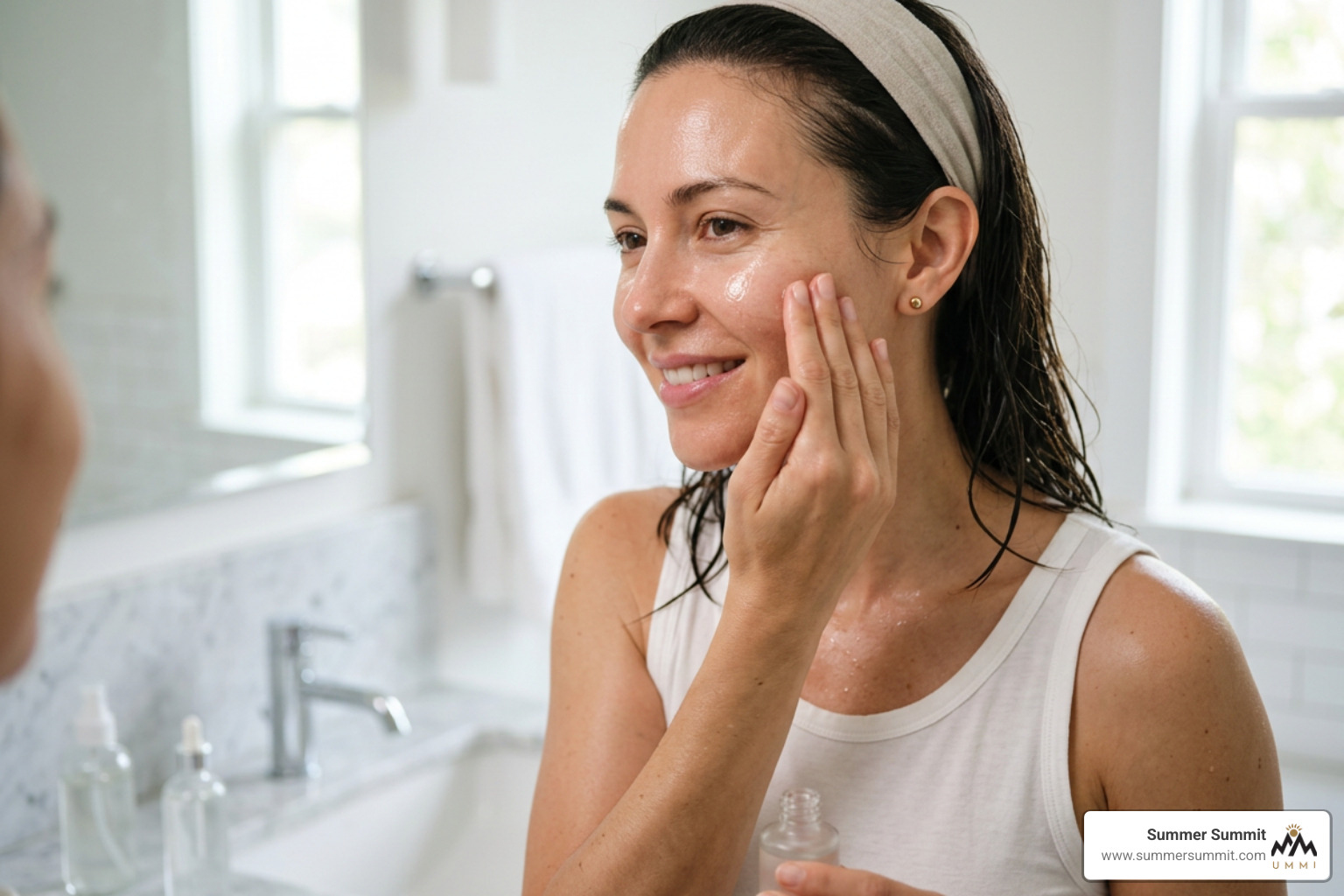
For a detailed walkthrough on seamlessly integrating this step into your morning and evening routines, read our guide on How Hyaluronic Acid Fits Into Your Skincare Routine (also available in Spanish as How Hyaluronic Acid Fits Into Your Skincare Routine). These application methods are widely utilized in professional clinical environments to maximize the efficacy of hydrating treatments.
Step-by-Step Guide to Layering a Hyaluronic Acid Serum
To get the absolute most out of your skincare routine, follow this step-by-step layering sequence every morning and evening.
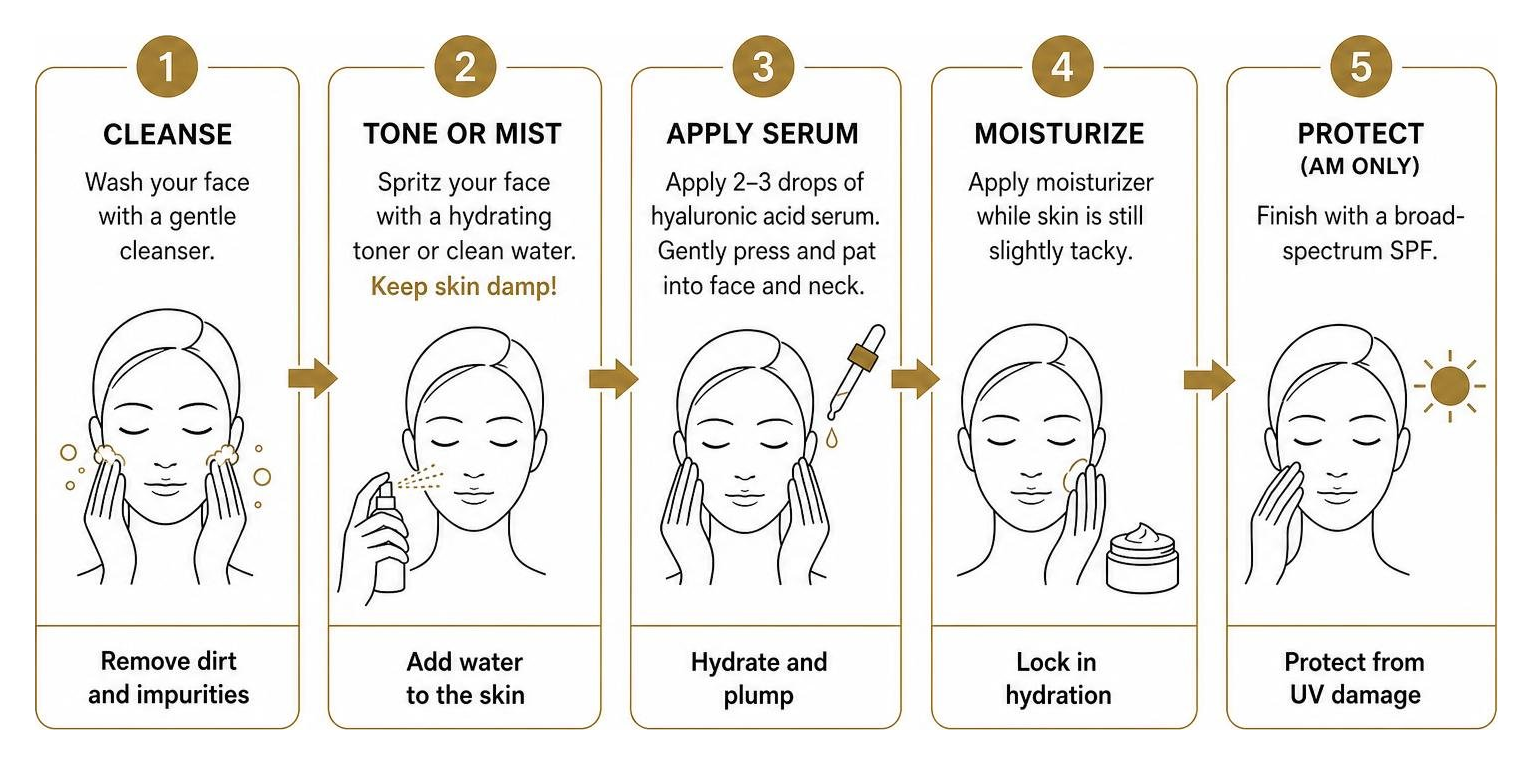
- Cleanse: Wash your face with a gentle, sulfate-free cleanser to remove dirt, oil, and impurities without stripping your natural lipids.
- Tone or Mist: Spritz your face with a hydrating toner or clean water. Keep the skin damp!
- Apply Serum: Dispense 2–3 drops of your hyaluronic acid serum onto your fingertips. Gently press and pat the serum into your face and neck. Avoid rubbing vigorously, which can cause micro-irritation.
- Moisturize: While your skin is still slightly tacky, apply your favorite moisturizer to lock in that newly bound hydration.
- Protect (AM Only): Finish your morning routine with a broad-spectrum SPF to protect your skin from UV damage, which naturally degrades your body's natural hyaluronic acid supplies.
What to Look For in a Premium Hyaluronic Acid Serum
Not all hydrating serums are created equal. Some budget-friendly options use cheap synthetic thickeners to give the illusion of a rich serum, while containing very little actual hyaluronic acid. Others use single-weight HA that simply dries on the skin surface without providing deep hydration.
When shopping for a high-quality serum, use the following comparison table to evaluate your options:
| Formulation Factor | Standard / Budget Serums | Premium / Summer Summit Standard |
|---|---|---|
| HA Molecular Weights | Single weight (usually high molecular weight only) | Multi-molecular weights (low, medium, high, and cross-polymer) |
| Active Concentration | Often unspecified, or diluted with synthetic polymers | Optimized clinical concentration (typically 1.5% to 2% pure HA) |
| Supporting Actives | None, or basic synthetic preservatives | Ceramides, Vitamin B5 (Panthenol), or firming peptides |
| Formulation Purity | May contain parabens, sulfates, and synthetic fragrances | Cruelty-free, sulfate-free, paraben-free, and irritant-free |
| Skin Feel | Can feel sticky, tacky, or pill under makeup | Lightweight, fast-absorbing, silky, and non-sticky |
| Dermatologist Standards | Mass-marketed without clinical oversight | Dermatologist-formulated and clinically tested for safety |
While some mass-market options offer bulk sizing, for daily facial care, we always recommend prioritizing multi-molecular, clean formulations that are specifically tailored to support your delicate skin barrier.
Frequently Asked Questions About Hydrating Serums
Skincare can be confusing, and myths about humectants abound. Here are direct, science-backed answers to the most common questions we receive.
Is hyaluronic acid safe for acne-prone and sensitive skin?
Yes, absolutely! Pure hyaluronic acid is naturally non-comedogenic and oil-free, meaning it will not clog your pores or trigger breakouts. In fact, many individuals dealing with acne find that adding a hydrating serum helps to balance their skin's sebum production. When your skin is dehydrated, it often overcompensates by producing excess oil, which can lead to clogged pores.
Furthermore, if you are using drying acne treatments like salicylic acid, benzoyl peroxide, or retinoids, a clean hyaluronic acid serum is an excellent way to soothe irritation and rebuild your compromised skin barrier.
How long does it take to see visible results?
The timeline for visible results is highly rewarding because hyaluronic acid works on multiple levels:
- Immediately (Within Minutes): You will notice an instant boost in surface hydration. Your skin will feel softer, smoother, and look slightly plumper due to the immediate binding of water to the stratum corneum.
- Within 1 Week: With twice-daily application, your skin barrier begins to stabilize. You will notice a reduction in dry patches and an improvement in overall skin texture.
- Within 4 Weeks: Clinical studies show that by week four, users experience a significant increase in skin elasticity and firmness.
- By 6 Weeks: Continued use leads to a measurable reduction in the depth of fine lines and wrinkles, alongside a 55% sustained increase in deep skin hydration.
Can hyaluronic acid cause side effects?
While hyaluronic acid itself is incredibly safe and highly tolerated by almost all skin types (including pregnant and breastfeeding individuals), side effects can occasionally occur due to application errors or poor formulations.
As mentioned earlier, applying HA to bone-dry skin in a very dry climate without a follow-up moisturizer can draw moisture out of your skin, leading to temporary dryness or tightness. Additionally, some mass-market serums contain harsh synthetic preservatives, alcohols, or artificial fragrances that can trigger contact dermatitis or redness. To avoid this, always perform a patch test on your inner arm before applying a new product to your face, and choose clean, dermatologist-formulated brands.
Conclusion
At the end of the day, achieving a healthy, radiant complexion isn't about chasing every fleeting beauty trend. It's about feeding your skin the essential biological components it needs to thrive. A premium hyaluronic acid serum is a foundational pillar of any effective skincare routine, delivering scientifically proven hydration, elasticity, and youthfulness.
At Summer Summit, we are dedicated to crafting premium, clinically proven skincare products that respect your biology. Our formulas are proudly cruelty-free, dermatologist-formulated, and entirely free of sulfates, parabens, and harmful irritants. We want you to feel completely confident in your skincare journey, which is why we back every single purchase with our 100% satisfaction guarantee and offer free shipping directly to your door.
If you have any questions or need personalized guidance on building your ideal hydration routine, reach out to our team of skincare experts.
Ready to discover the difference that clinical-grade hydration can make for your skin?
https://summersummit.com/es/blogs/news/whats-with-the-hype-about-hyaluronic-acid-ha
Dejar un comentario