

Can You Use Vitamin C and Tretinoin Eye Creams Together?
Why Vitamin C and Tretinoin Eye Cream Is Worth Getting Right
Using a vitamin C and tretinoin eye cream is one of the most effective ways to target dark circles, fine lines, and puffiness — but only if you choose the right products and use them correctly.
Here's a quick answer if you're short on time:
- Yes, you can use vitamin C and tretinoin around the eyes — but formulation and concentration matter enormously
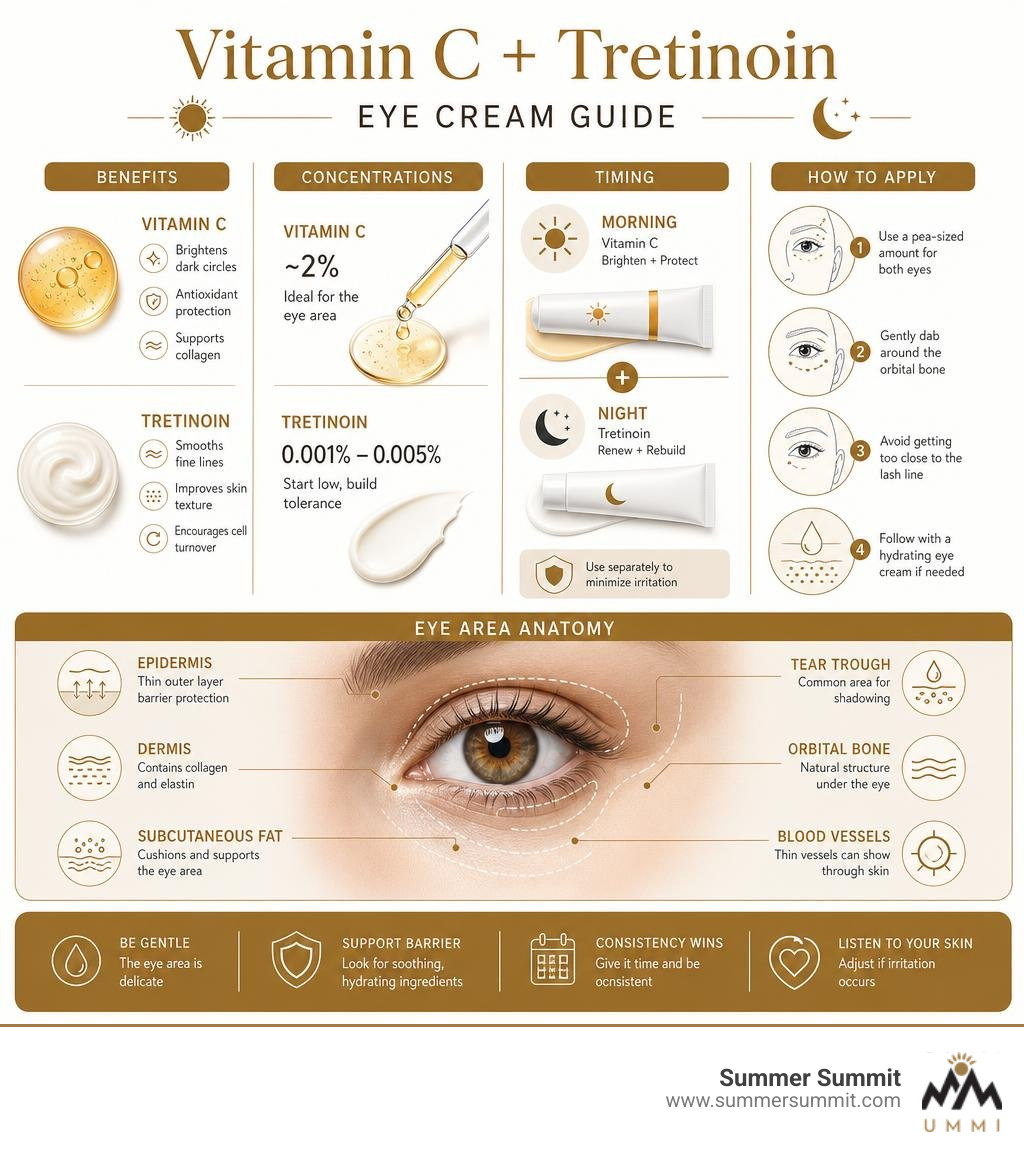
- Vitamin C (ideally around 2% for the eye area) brightens dark circles and supports collagen
- Tretinoin (as low as 0.001%–0.005% for eye use) improves skin texture and speeds cell turnover
- Use them separately — vitamin C in the morning, tretinoin at night — to minimize irritation
- Look for eye-specific formulas with soothing, hydrating ingredients like ceramides, hyaluronic acid, and caffeine
The skin under your eyes is roughly 60% thinner than the rest of your face. That means active ingredients that work well on your cheeks can be far too harsh here. Most people run into trouble not because these ingredients don't work — they do — but because they use the wrong concentrations or skip the right supporting ingredients.
This guide cuts through the noise. It covers the science, the safe application techniques, and the specific formulations worth considering.
I'm Robert McCann, founder of Summer Summit Skincare, where I've spent years working directly with labs on evidence-based formulations — including researching how actives like vitamin C and tretinoin eye cream combinations can be developed for safety and real results. In the sections ahead, I'll walk you through exactly what to look for and what to avoid.
The Science of Combining Vitamin C and Tretinoin Eye Cream
To understand why a vitamin C and tretinoin eye cream approach is so powerful, we have to look at how these two heavyweights interact with our skin biology. Think of them as the ultimate dynamic duo of dermatology: one defends your skin during the day, while the other rebuilds it at night.
Collagen Synthesis and Cell Turnover
As we age, our natural skin cell turnover slows down. In young adults, a full cycle takes about 28 days, but as we head deeper into our thirties and beyond, it can stretch to 40 days or more. This slow-motion renewal leaves dead, dull cells lingering on the surface, making fine lines look deeper and skin texture appear crepey.
Tretinoin — a highly potent, prescription-strength retinoid derived from Vitamin A — is up to 20 times stronger than traditional over-the-counter retinol. It works by accelerating this sluggish cell turnover, prompting the skin to shed old cells and generate fresh ones. Simultaneously, tretinoin reorganizes collagen bundles and triggers the production of new collagen in the dermis, which increases epidermal thickness over time.
While tretinoin is busy rebuilding the structural scaffolding, vitamin C acts as an essential cofactor for collagen synthesis. Without vitamin C, your body cannot efficiently stabilize or cross-link collagen molecules. By incorporating vitamin c the powerful skin brightening agent into your routine, you are providing the essential raw materials your skin needs to build strong, resilient tissue.
Tackling Under-Eye Concerns: Hyperpigmentation, Periorbital Edema, and Skin Laxity
Under-eye issues usually stem from three distinct biological causes:
- Hyperpigmentation: Dark circles can be caused by an overproduction of melanin. Vitamin C excels here because it inhibits the tyrosinase enzyme, which is responsible for melanin production. This prevents dark spots from forming and brightens existing shadows. Tretinoin complements this by decreasing the size of the melanocyte Golgi complex and endoplasmic reticulum, which reduces overall melanin production and disperses pigment clumps more evenly.
- Periorbital Edema (Puffiness): Fluid retention under the eyes makes us look tired even after eight hours of sleep. While vitamin C provides antioxidant protection to strengthen capillary walls, tretinoin improves skin elasticity, ensuring the skin remains firm enough to resist fluid pooling.
- Skin Laxity: Thinning skin allows the underlying purple blood vessels to show through, creating the illusion of deep dark circles. This is known as vascular dark circles or haemostasis. By boosting collagen and thickening the delicate skin barrier, both actives work together to "opaque" the skin, making those tiny blood vessels much less visible.
According to a detailed breakdown of how these two ingredients interact on Tretinoin and Vitamin C: Everything You Need to Know | RedBox Rx , using them in a coordinated routine maximizes their complementary strengths. While tretinoin increases cell turnover, vitamin C provides the antioxidant defense needed to protect those fresh, new skin cells from daily UV damage and environmental stress.
How to Safely Layer Actives Around the Delicate Eye Area
Because the periorbital skin is so thin and has very few sebaceous (oil) glands, applying highly concentrated active ingredients directly to this area is a recipe for redness, peeling, and irritation. To get the benefits of a vitamin C and tretinoin eye cream routine without the dreaded "retinoid uglies," you must master the art of safe application.

The Orbital Bone Rule and the "Sandwich Technique"
When applying any high-potency eye treatment, never place the product directly onto your eyelids or right up against your lower lash line. Tretinoin travels naturally through the skin's lipid layers. Instead, apply the product along your orbital bone (the hard structure surrounding your eye socket). Tap it gently using your ring finger, moving from the outer corner inward. The product will naturally migrate to where it is needed without migrating into your eyes and causing severe irritation.
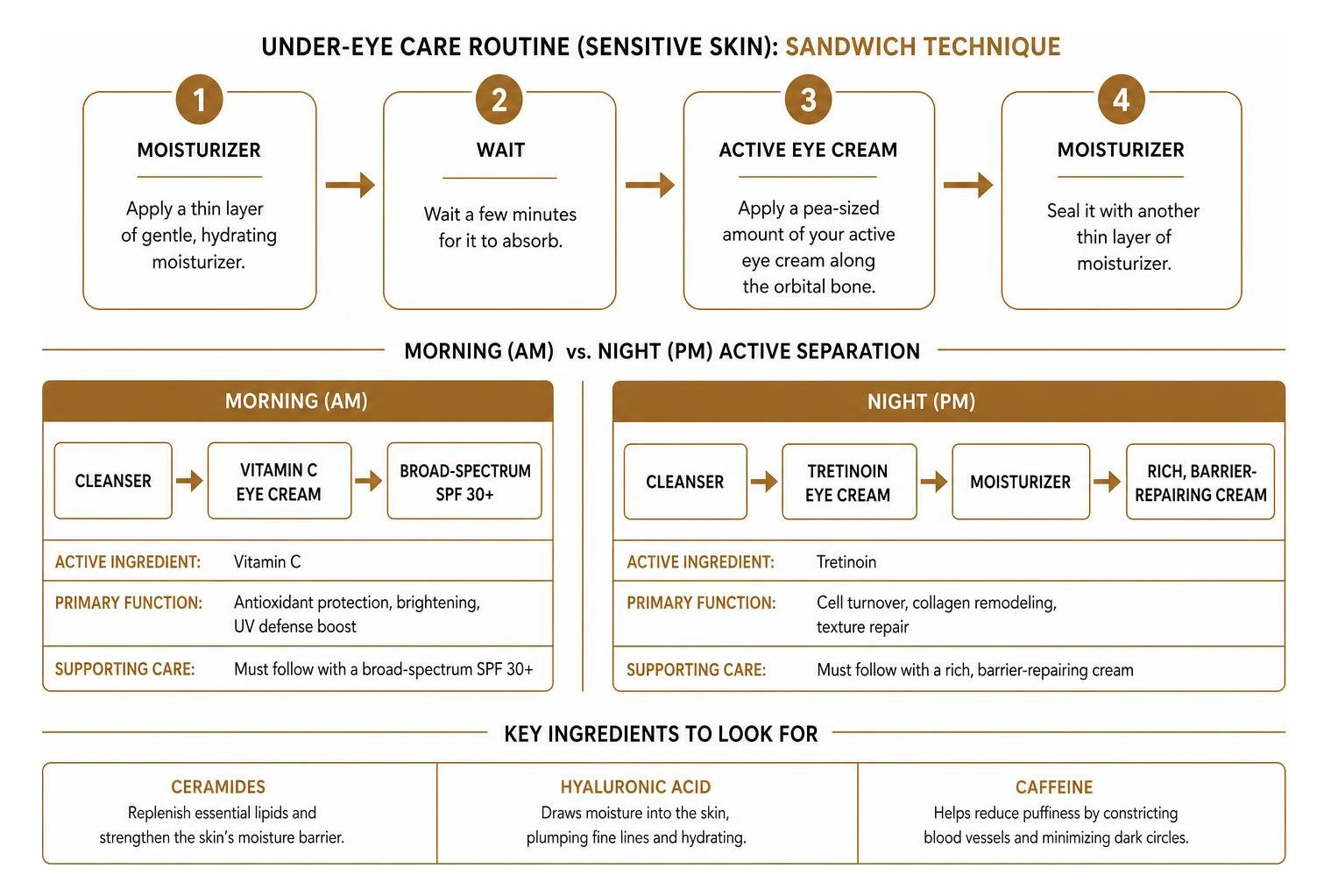
If your skin is highly sensitive, we highly recommend utilizing the sandwich technique:
- Apply a thin layer of a gentle, hydrating moisturizer first.
- Wait a few minutes for it to absorb.
- Apply a tiny, pea-sized amount of your active eye cream along the orbital bone.
- Seal it with another thin layer of moisturizer.
This creates a protective buffer that slows down the absorption rate of the active ingredients, drastically reducing the risk of irritation while still delivering the long-term benefits of using under eye cream.
pH Compatibility and Morning vs. Night Separation
Pure vitamin C (L-ascorbic acid) requires a highly acidic pH (around 2.5 to 3.5) to penetrate the skin. Tretinoin, on the other hand, works best at a more neutral pH (around 5.5 to 6.0). Layering them directly on top of each other can destabilize both ingredients, rendering them ineffective and highly irritating to the skin barrier.
To prevent this chemical conflict, dermatologists universally recommend dividing your application by time of day:
| Active Ingredient | Recommended Timing | Primary Function | Supporting Care Required |
|---|---|---|---|
| Vitamin C | Morning (AM) | Antioxidant protection, brightening, UV defense boost | Must follow with a broad-spectrum SPF 30+ |
| Tretinoin | Night (PM) | Cell turnover, collagen remodeling, texture repair | Must follow with a rich, barrier-repairing cream |
By keeping your vitamin C in the morning and your tretinoin at night, you eliminate any issues with pH compatibility, maximize the protective benefits of antioxidants during daylight hours, and allow tretinoin to work undisturbed during your skin's nocturnal repair cycle.
Best Eye Creams to Pair with Tretinoin and Vitamin C
If you are using a prescription-strength tretinoin or a highly concentrated vitamin C serum, you need a supporting cast of nourishing, barrier-restoring eye creams to keep your skin hydrated and resilient.
When selecting products to pair with these powerful actives, look for formulas rich in the following ingredients:
- Ceramides: These essential lipids act as the "mortar" between your skin cell "bricks." Because retinoids can temporarily deplete ceramides, using a cream that replenishes them is vital for maintaining a healthy moisture barrier.
- Hyaluronic Acid: This humectant draws moisture into the skin, instantly plumping up fine lines and combatting the dryness often caused by tretinoin.
- Caffeine: Excellent for constricting blood vessels, caffeine temporarily reduces periorbital edema (puffiness) and minimizes the blue-black shadows of vascular dark circles.
- Niacinamide (Vitamin B3): A superb anti-inflammatory that calms redness, supports barrier function, and works synergistically with vitamin C to fade hyperpigmentation.
To learn more about how to structure these ingredients in your routine, explore our guides on layering vitamin c and e together in a serum and safely integrating retinol in your skincare routine.
Formulations with Vitamin C and Tretinoin Eye Cream Compatibility
While some advanced formulations attempt to combine derivatives of vitamin C and retinoids into a single bottle, doing so requires highly specialized chemistry to keep both actives stable.
Low-Dose Tretinoin vs. Face Strengths
A standard face prescription for tretinoin typically ranges from 0.025% to 0.1%. Applying these concentrations to the delicate under-eye area is highly likely to cause contact dermatitis, peeling, and severe dryness.
In contrast, eye-specific custom formulas generally utilize incredibly low doses — often around 0.001% to 0.005% tretinoin. These micro-doses are specifically calibrated to stimulate collagen and increase cell turnover in thin skin without triggering a massive inflammatory response.
Choosing the Right Vitamin C Derivative
L-ascorbic acid is the most bioavailable form of vitamin C, but it is also the most unstable and irritating. For the eye area, look for gentler, lipid-soluble derivatives such as tetrahexyldecyl ascorbate (THD ascorbate) or magnesium ascorbyl phosphate.
To understand why this ingredient is a game-changer for sensitive skin, check out our deep dive on tetrahexyldecyl ascorbate in your skin care. THD ascorbate is highly stable, neutral in pH, and penetrates deep into the lipid layers of the skin where collagen is produced, providing excellent brightening benefits without the sting.
Insights from Clinical Research
The power of combining gentle retinoids with vitamins was highlighted in a classic clinical study published in The Journal of Cosmetic Dermatology. Researchers evaluated The effects of topical application of phytonadione, retinol and vitamins C and E on infraorbital dark circles and wrinkles of the lower eyelids .
The study found that a topical gel containing 2% phytonadione (Vitamin K1), 0.1% retinol, and 0.1% vitamins C and E was fairly to moderately effective in reducing under-eye dark circles in 47% of patients after 8 weeks of twice-daily use. The treatment was particularly effective for dark circles caused by haemostasis (blood pooling), while also delivering a noticeable reduction in fine lines and wrinkles. This research underscores that lower, gentler concentrations of active ingredients, when combined with barrier-supporting vitamins, can yield impressive clinical results with minimal side effects.
Gentle Alternatives for Sensitive Under-Eyes
Not everyone's skin can tolerate prescription tretinoin around the eyes, and that is completely okay! If you have highly sensitive skin, eczema, or are simply new to active skincare, there are several highly effective, gentle alternatives that deliver beautiful results without the risk of irritation.
Bakuchiol and Retinyl Palmitate
If traditional retinoids leave your skin red and peeling, consider these gentler options:
- Bakuchiol: A plant-derived antioxidant that targets the same cellular pathways as retinol to boost collagen and speed cell turnover, but without any of the associated dryness or irritation.
- Retinyl Palmitate: A very mild vitamin A derivative that the skin slowly converts into retinoic acid. It is incredibly gentle, making it perfect for beginners. To learn more, read our guide on retinyl palmitate vitamin a and your skincare.
Polypeptides and Soothing Botanical Extracts
Polypeptides are short chains of amino acids that act as chemical messengers, telling your skin to produce more collagen and elastin. They are highly effective at firming the skin and smoothing fine wrinkles without causing any inflammation.
Pairing a polypeptide serum with a nourishing, irritant-free eye cream is a fantastic way to rebuild the skin barrier. For sensitive skin care, we recommend checking out our specialized formulas: the gentle firming eye cream, our gentle polypeptide serum eyes, and our gentle eye cream irritant free.
Note: If you are currently pregnant or nursing, tretinoin and other retinoids should be avoided entirely. For a safe, glowing alternative, we suggest reviewing our guide on choosing a vitamin c serum pregnancy safe.
Frequently Asked Questions about Under-Eye Actives
Is it Safe to Use a Combined Vitamin C and Tretinoin Eye Cream?
Yes, but only if the product has been specifically formulated, stabilized, and clinically tested for the delicate eye area.
Never attempt to DIY your own mixture by blending prescription face tretinoin with a high-strength vitamin C face serum in your palm. This will almost certainly cause severe irritation, contact dermatitis, or a damaged skin barrier.
If you want to explore how these formulations are structured, you can review official product listings such as the DailyMed - VITAMIN C BRIGHTENING EYE CREAM liquid label guidelines to see how professional formulations balance active concentrations with soothing bases.
Can I use tretinoin on my eyelids?
Absolutely not. The skin on your eyelids is the thinnest on your entire body and has virtually no oil glands to protect itself. Applying tretinoin directly to your eyelids or too close to your lash line can cause severe dryness, burning, scaling, and may even damage your meibomian glands (the glands responsible for keeping your eyes lubricated), leading to chronic dry eye. Always stick to the orbital bone.
How long does it take to see results from under-eye retinoids?
Patience is key! Skincare is a marathon, not a sprint. While some hydrating eye creams can show immediate plumping benefits due to ingredients like hyaluronic acid, true structural changes take time:
- Weeks 1 to 4: The adjustment phase. You may experience some mild dryness or peeling as your skin cell turnover begins to accelerate.
- Weeks 8 to 12: You will begin to notice visible improvements in skin texture, a reduction in the appearance of fine lines, and a brighter under-eye tone.
- 6 Months and Beyond: Long-term collagen synthesis kicks in, leading to firmer, more resilient skin and a lasting reduction in deep wrinkles.
Conclusion
Navigating high-potency skincare doesn't have to be a battle between efficacy and comfort. By understanding how to safely layer a vitamin C and tretinoin eye cream routine — separating your vitamin C to the morning and your tretinoin to the night, while keeping applications strictly along the orbital bone — you can achieve a brighter, smoother, and more youthful gaze without compromising your skin barrier.
At Summer Summit, we are dedicated to developing premium, clinically-proven skincare formulations that deliver real, visible results. Every product we create is dermatologist-formulated, cruelty-free, and completely free of sulfates, parabens, and harmful irritants. We stand behind our work with a 100% satisfaction guarantee and offer free shipping on all orders, ensuring your path to healthy skin is entirely stress-free.
Ready to take your brightening routine to the next level? Discover our Kojic Acid and Vitamin C Cream and experience the power of advanced, barrier-safe skincare designed for real results.
Dejar un comentario