

One and Done: Can You Really Apply Sunscreen Just Once?
Why All Day Sun Protection Is Harder Than You Think
All-day sun protection is one of those things most of us think we're doing right — but probably aren't.
Here's a quick answer if you need it fast:
How to get real all-day sun protection:
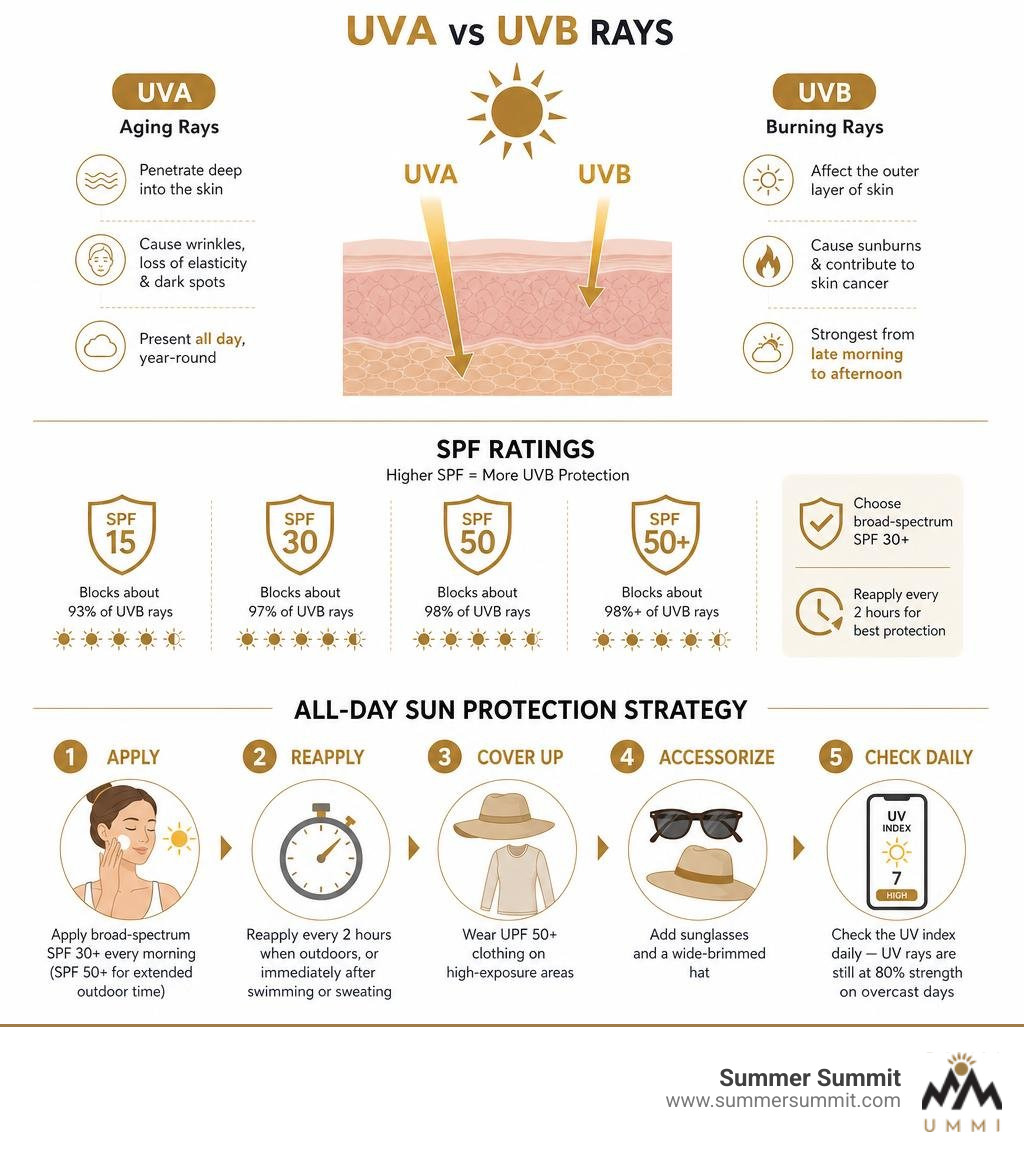
- Apply broad-spectrum SPF 30+ sunscreen every morning (SPF 50+ for extended outdoor time)
- Reapply every 2 hours when outdoors, or immediately after swimming or sweating
- Wear UPF 50+ clothing on high-exposure areas
- Add sunglasses and a wide-brimmed hat
- Check the UV index daily — UV rays are still at 80% strength on overcast days
The numbers are hard to ignore. More than 5 million cases of skin cancer are diagnosed in the US every year, making it the most common cancer. One in five Americans will develop skin cancer by age 70. And up to 90% of visible skin aging comes from sun exposure — not time.
The uncomfortable truth? A single morning application of sunscreen is rarely enough. Sunscreen breaks down, rubs off, and washes away throughout the day — often faster than people expect.
This article walks you through what actually works, what doesn't, and how to build a routine that holds up from morning to evening.
I'm Robert McCann, founder of Summer Summit Skincare, and through years of hands-on formulation work and ingredient research, I've developed a deep understanding of what it takes to achieve genuine all-day sun protection — including where most products and routines fall short. Let's get into it.
The Myth of the Single Application: Why All Day Sun Protection Requires a Strategy
We have all been there. It is a beautiful, bright morning, and you diligently slather on your favorite SPF before heading out the door. You feel invincible, shielded by an invisible armor that you assume will last until the sun goes down.
Unfortunately, this "one and done" approach is a dangerous myth. Relying on a single morning application leaves your skin highly vulnerable to both DNA-damaging ultraviolet (UV) radiation and premature cosmetic aging.
To understand why, we have to look at how skin cancer and photoaging develop. Ultraviolet B (UVB) rays are the primary culprits behind sunburns and play a key role in the development of skin cancers, including deadly melanomas. Ultraviolet A (UVA) rays penetrate much deeper into the skin's dermis, breaking down collagen and elastin fibers, which leads to sagging, deep wrinkles, and hyperpigmentation.
Because UV rays can damage skin cells in as little as 15 minutes—even on completely overcast days—relying on a single morning layer simply cannot provide the sustained defense your skin needs. To dive deeper into why consistent daily protection is non-negotiable, check out our guide on 5 Compelling Reasons to Use Sunscreen Every Day.
The Science Behind All Day Sun Protection Claims
When a product claims to offer "all-day" or "8-hour" protection, it is important to look closely at the science. Sunscreen active ingredients work by either absorbing UV light and converting it to heat, or by physically reflecting the rays away from your skin.
Over time, these active ingredients undergo a process called photodegradation. As they absorb UV photons, their chemical structures gradually break down, rendering them less effective.
Furthermore, Sun Protection Factor (SPF) ratings are determined under highly controlled laboratory conditions. The math of SPF is straightforward but often misunderstood:
- SPF 15 blocks roughly 93% of UVB rays.
- SPF 30 blocks roughly 97% of UVB rays.
- SPF 50 blocks roughly 98% of UVB rays.
However, these percentages only hold true if the sunscreen remains fully intact on your skin. Even if a specialized "once-a-day" formulation binds tightly to the outermost layer of your skin (the stratum corneum), it cannot prevent the physical disruption caused by your body's natural processes.
Reapplication Realities: When and Why Sunscreen Fails
In the real world, your skin is a dynamic, living organ. It sweats, secretes sebum (oil), and sheds dead skin cells. These natural processes constantly push the sunscreen barrier away from the skin surface.
External factors speed up this breakdown even further:
- Sweat and Water: Even highly water-resistant formulas begin to lose their grip after 40 to 80 minutes of moisture exposure.
- Friction: Every time you wipe your brow, touch your face, put on a pair of sunglasses, or dry off with a towel, you physically scrape away portions of your protective layer.
- Under-Application: Most people apply only a fraction of the amount of sunscreen required to achieve the SPF rating on the bottle. To fully protect your face and neck, you need about half a teaspoon of product. For full-body coverage, you need at least a full ounce (roughly the size of a shot glass).
To keep your defense strong, watch out for these incredibly common sunscreen application mistakes:
- The "Cloudy Day" Pass: Assuming clouds block UV rays. In reality, up to 80% of UV radiation penetrates light cloud cover.
- Skipping the "Hidden" Spots: Forgetting the ears, the back of the neck, the tops of the feet, and the lips.
- Using Expired Products: Sunscreen active ingredients degrade over time inside the bottle, especially if left in hot cars or direct sunlight.
- Relying Solely on SPF Makeup: You would have to apply several times the normal amount of foundation or powder to reach the listed SPF, which would look incredibly cakey and heavy.
Mineral vs. Chemical Sunscreens: Choosing Your Daily Shield
When building your all-day sun protection strategy, one of the first decisions you will face is choosing between mineral (physical) and chemical sunscreens. Both have distinct mechanisms, benefits, and drawbacks.
| Feature | Mineral (Physical) Sunscreens | Chemical Sunscreens |
|---|---|---|
| Active Ingredients | Zinc Oxide, Titanium Dioxide | Avobenzone, Homosalate, Octisalate, Octinoxate |
| How It Works | Reflects, scatters, and absorbs UV rays at the skin surface | Absorbs UV rays and converts them into harmless heat |
| Application Timing | Works immediately upon application | Requires 15 to 20 minutes to fully bind to the skin |
| Skin Sensitivity | Very gentle; highly recommended for sensitive or reactive skin | Can sometimes cause irritation or stinging, especially around the eyes |
| Texture & Finish | Historically heavier, though modern formulations can be quite elegant | Typically lightweight, invisible, and easy to layer under makeup |
| Environmental Impact | Non-nano options are generally considered reef-friendly | Certain chemical filters (like oxybenzone) are restricted in some regions |
Physical Blockers: Zinc Oxide and Titanium Dioxide
Mineral sunscreens rely on natural mineral compounds—specifically zinc oxide and titanium dioxide—to form a physical barrier over your skin. These minerals act like tiny mirrors, reflecting and scattering incoming UV rays, while also absorbing a significant portion of them.
One of the greatest advantages of mineral sunscreens is that they offer immediate protection. Because they sit on top of the skin rather than needing to absorb into it, you do not have to wait 15 minutes before stepping outside.
Furthermore, zinc oxide is incredibly soothing and is widely considered the gold standard for sensitive, inflamed, or acne-prone skin. If you struggle with redness or irritation, read more about how mineral ingredients can transform your routine in our deep dive on Zinc Oxide and Your Skincare.
Finding the right formula is key, especially when dealing with easily irritated skin types. For a curated list of gentle, protective options, browse our guide on the Best Sun Creams for Sensitive Skin.
Chemical Absorbers: How They Work and When to Reapply
Chemical sunscreens utilize organic carbon-based compounds such as avobenzone, homosalate, octisalate, and octocrylene. Instead of sitting on top of the skin, these ingredients absorb into the upper layers. When UV light hits your skin, these chemicals absorb the energy, convert it into heat, and release it from the body.
Because chemical filters absorb completely into the skin, they tend to offer a highly desirable, weightless, and completely invisible finish. This makes products like the Daily UV Defense Sunscreen SPF 50+ - Innisfree incredibly popular for daily use under makeup.
However, chemical sunscreens require a strict application window. You must apply them at least 15 to 20 minutes before sun exposure to allow the chemical lattice to fully bond with your skin.
Additionally, because these active ingredients actively break down as they neutralize UV light, strict reapplication every two hours is absolutely vital to maintain your shield. If you are spending time in coastal areas or need expert guidance on clinical-grade sun care, consulting professionals at a dedicated center like Sunscreen in Jupiter & Palm Beach Gardens, Florida can help you tailor your product selection perfectly.
Beyond the Bottle: Layering Strategies for Comprehensive Defense
While topical sunscreen is a cornerstone of skin health, relying on it alone for all-day sun protection is like building a house with only one wall. Truly comprehensive defense requires a multi-layered approach that combines skincare, specialized textiles, and smart lifestyle habits.

The Rise of UPF 50+ Apparel
One of the most effective ways to simplify your sun protection routine is to let your clothing do the heavy lifting. Ultraviolet Protection Factor (UPF) is the textile equivalent of SPF. While SPF measures protection against UVB rays on the skin, UPF measures how much UVA and UVB radiation a fabric blocks.
A standard white cotton T-shirt has a surprisingly low UPF rating of around 5, which drops even lower if the fabric gets wet. This means a significant amount of UV radiation passes straight through your clothes to your skin.
In contrast, UPF 50+ certified garments block at least 98% of all harmful UV rays. This protection is achieved mechanically through tight fabric density, specialized weaving techniques, and fiber selection (such as bamboo viscose and polyester blends), rather than chemical additives. This mechanical block means the protection will not wash out over time.
To build a chic, highly protective wardrobe, look for garments certified under rigorous international textile standards like EN 13758-1:
- For Active Days: The Unisex All Day, Everyday UPF 50+ Sun Shirt – Sun Ray offers a relaxed fit and excellent breathability, making it perfect for transitioning from a morning hike to an outdoor lunch.
- For Daily Elegance: The lightweight, beautifully draped Women's Pink UV Protective Long Shirt, Antibes, UPF 50+– Ker Sun provides sophisticated coverage with an innovative, soft feel.
- For Layerable Versatility: The Everlight Loose Fit Jacket UPF 50+ | Women's Sun Protective jacket Solbari features built-in cooling technology, hand covers, and a ponytail-friendly hood for complete upper-body defense.
- For Effortless Style: The Women's Beige UV Kimono, Rimini, UPF 50+– Ker Sun offers a flowing, loose-cut option that easily layers over any outfit while keeping sensitive skin fully protected.
Layering Techniques for All Day Sun Protection
To achieve a truly bulletproof defense, you can seamlessly layer multiple physical, topical, and environmental strategies.
- The Antioxidant Base Layer: Before applying your sunscreen in the morning, apply an antioxidant serum. Vitamin C, particularly in highly stable forms like Tetrahexyldecyl Ascorbate, acts as a secondary defense line. It neutralizes the free radicals that slip past your sunscreen, boosting your skin's natural resilience. Learn how to incorporate this powerhouse into your routine by reading Tips for Summer Skincare: Keeping Your Skin Healthy and Radiant and our guide on Tetrahexyldecyl Ascorbate in Your Skin Care.
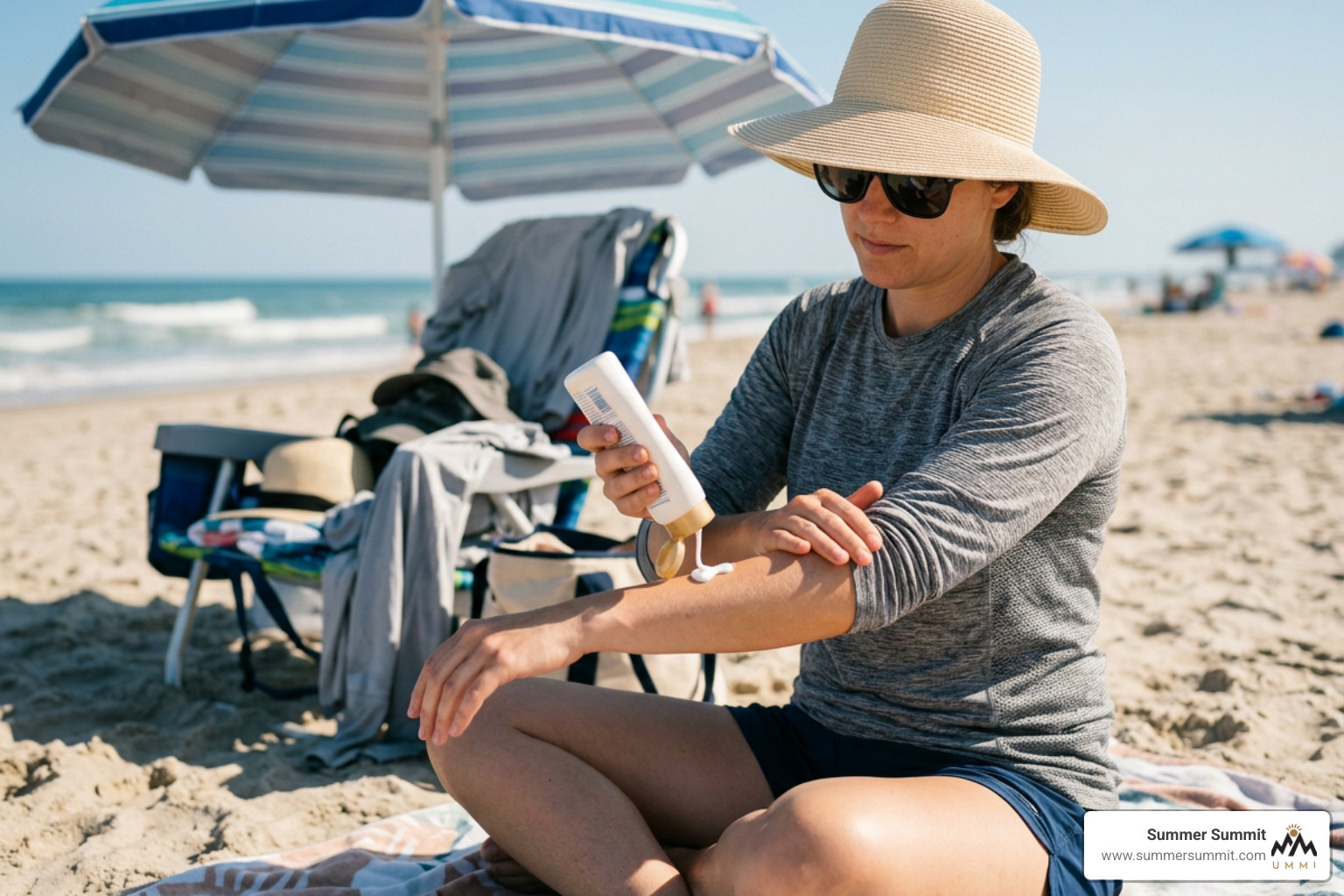
- The Topical Shield: Apply your broad-spectrum SPF 30+ or SPF 50+ mineral sunscreen generously over your serum, allowing it to dry completely.
- The Physical Barrier: Layer on your UPF 50+ clothing, slip on a pair of UV-blocking sunglasses to protect your eyes, and wear a wide-brimmed hat to shade your face and scalp.
- Environmental Controls: Do not forget that UV rays pass easily through standard glass windows—whether you are driving or working near a window at home. Installing specialized window films or protective outdoor structures can dramatically lower your daily ambient exposure. To explore options for your home or patio, you can Contact SPF Screens & Awnings Today to set up a professional consultation.
Frequently Asked Questions about Sun Protection
Which sunscreens have the Skin Cancer Foundation Seal of Recommendation?
The Skin Cancer Foundation's Seal of Recommendation is a highly trusted, globally recognized symbol of safe and effective sun protection. To earn this seal, a manufacturer must submit clinical data proving their product meets strict scientific criteria.
This data is thoroughly reviewed by a volunteer Photobiology Committee—a group of independent, leading experts in how light interacts with biological systems.
As of June 2026, the criteria require daily-use sunscreens to have an SPF of 15 or higher, and active-use sunscreens (for extended outdoor time) to have an SPF of 30 or higher, along with proven broad-spectrum protection against both UVA and UVB rays.
It is important to note that manufacturers are not legally required to display the Seal on their packaging even if they have earned it. To find the most up-to-date, verified list of approved products, you can search the official Skin Cancer Foundation Seal of Recommendation database.
Does makeup with SPF provide enough protection for the whole day?
In short: no. While makeup containing SPF is a wonderful added bonus, it should never be your primary source of sun protection.
To achieve the SPF rating listed on a foundation, skin tint, or powder, you would have to apply roughly seven to ten times the amount of makeup that a person would normally wear. Applying that much product would result in a very heavy, mask-like appearance.
Furthermore, makeup is rarely applied evenly across the entire face, leaving vulnerable gaps along the jawline, temples, and nose. For real, all-day security, always apply a dedicated sunscreen first, let it set, and then apply your makeup on top.
How does the UV Index affect my daily sunscreen application?
The UV Index is an international standard measurement of the strength of sunburn-producing ultraviolet radiation at a particular place and time. It typically ranges from 0 (very low risk) to 11+ (extreme risk).
Many people believe they only need sunscreen when the UV Index is high, but UV radiation can damage your skin cells in as little as 15 minutes, even on cloudy or cool days.
Always check the local UV Index as part of your morning routine. During peak hours (typically between 10 AM and 4 PM), or when the UV Index is 3 or higher, you should combine your topical sunscreen with physical barriers like UPF clothing and hats, and seek shade whenever possible.
Conclusion
Achieving true all-day sun protection is not about finding a single, magical product that you only have to apply once. Instead, it is about building a thoughtful, consistent routine that combines high-performance topical skincare with physical barriers like UPF 50+ clothing and smart daily habits.
At Summer Summit, we are dedicated to helping you achieve healthy, radiant skin at every stage of life. Our dermatologist-formulated, cruelty-free skincare products are entirely free of sulfates, parabens, and harsh irritants, making them perfect for even the most sensitive skin types. We back everything we make with a 100% satisfaction guarantee and offer free shipping to make your skincare journey as seamless as possible.
To discover more expert tips, deep-dives into clinical ingredients, and seasonal skincare advice, visit our Summer Summit Skincare Blog. Protect your skin today, and it will thank you for decades to come!
Leave a comment